


Here are a few ideas and thoughts on how to get the most out of creating a character for Daggerheart RPG by Darrington Press.
One of my groups is about to finish a 2-year-long D&D campaign and has decided to use Daggerheart for our next game. As many veteran D&D players do, the group has browsed the book and begun pairing ancestry with class. I’m already running one campaign using Daggerheart and have run a few other games with the system. There are a few things I find lacking when this tried-and-tested method of building a character is used for a game like Daggerheart, which is as narrative-first as they come.
So, I told the group to hold off on thoughts about the mechanics of the game and asked them to wait until we had the all-important session 0, where we agreed on how the characters know each other, where they are from, and so on (see page 169 in the Daggerheart rulebook). In my opinion, decisions made during session 0 matter most and make Daggerheart the great game it is.
To illustrate why this is especially important in Daggerheart, I am going to rely on a well-known D&D literature, the Dragonlance Chronicles. I think by looking at this narrative through the Daggerheart lenses, one might get a sense of what kind of game and tension the designers of Daggerheart had in mind. Of course, I might as well use the Mighty Nein or Vox Machina, and it might even be more appropriate, but since I am closing in on turning fifty, I prefer to stick to what is more familiar to me.
Darn C.A.T.S.!
If you have played D&D for more than a few years, you have probably heard about the Dragonlance Classics campaign, published by TSR in the ’80s, and the novels using the same narratives. In a story as old as D&D, the narrative centers on a band of heroes who bring back the true gods to Krynn and thwart the evil goddess Takhisis’s plans to seize the world. More or less, business as usual for D&D heroes. However, I want to highlight not the narrative but the group and their relationships.
In the Daggerheart rulebook, groups are recommended to start session 0 by agreeing on C.A.T.S. Not the feline creatures, but on Concept, Aim, Tone, and Subject.
Concept
Concept, in short, is the campaign pitch. This is where you decide on what the group is about to do. It might be as simple as clearing the local sewers of rats, or as grand as taking on the gods themselves. In Dragonlance, the concept would be something like: In the shadow of war, a group of friends return home and meet again after a few years apart, searching for clues of the old gods, only to find one there. Could it bring back the gods?
Aim
Aim is what you want your campaign to achieve. Are you planning on a weekly game session in a world steeped in lore, or are you just a few friends who want to hang out and slay monsters? The aim of the Dragonlance narrative might be to tell a tale of despair and grief, in which hope is found in friendship and relationships, in a world recovering from a cataclysmic event.
Tone
Next, you agree on the narrative’s tone. It could be adventurous, goofy, funny, romantic, scary, or whatever you want it to be, as long as every participant agrees on it. The Dragonlance campaign is serious for most parts, but has its comic relief in characters like Fizban and Tasselhoff. These lighten the mood in an otherwise serious narrative.
Subject
Finally, you decide the subject of the narrative. This is where you decide on which topics the narrative touches or avoids. Some topics may be sensitive to certain players for one reason or another, and it is important to respect everyone’s wishes. In Dragonlance Classics, the group faces the oppressive forces of an evil deity aided by dragons, and the group’s role is to bring balance and restore hope as they battle the dragonarmies.
Starting point, Concept, and Relationships
One of the best parts of creating a character in Daggerheart is building relationships with both the other player characters and the non-player characters. This is where the tension lies, where drama is born, and I always ask my players to really sink their teeth into this part. Unlike D&D, Daggerheart is a narrative-first game, and it is so important for every participant to embrace this in character creation.
Starting Point
Once the C.A.T.S. are out of the way, I tend to ask a few questions about the group’s starting point. Where did you meet? What do we know about that place? Even when I am using a developed or published setting, I ask, since it creates a base, a place where the narrative starts. This is not only good information for the Game Master but also important for the player characters, as the starting point might shape their choices of ancestry or classes.
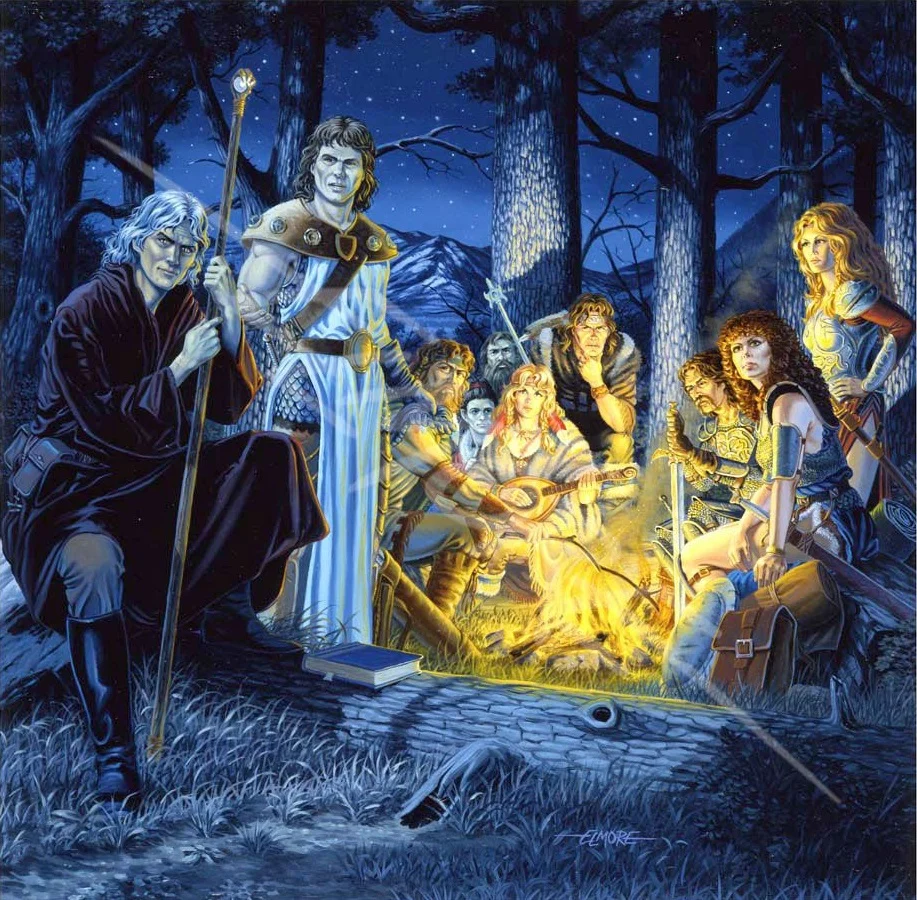
In Dragonlance, the group of adventurers all have some connection to a small village called Solace. They frequented an inn called the Inn of the Last Home before heading out in their own directions, each following their own goals. As they have decided to meet again after a given time, each is heading back to Solace when the narrative starts. Each character has their own personalized connection to Solace, but knows the same people there, Otik the innkeeper, Tika, who helps Otik, Kitiara, the twins’ half-sister, and so on.
Concept
Before you decide on ancestry and class, make sure you follow the rulebook’s suggestion and create a concept for your character. This is what the other player characters will tie into; this is the starting point of your relationships. Your character concept might be as simple as a travelling musician wandering from town to town, or as detailed as a short story about a blacksmith who lost his wife and daughter in a tragic fire for which he was blamed, then ran away and became an outlaw.
In Dragonlance, the concepts are not overly complicated. Tanis is a half-breed, never fully knowing where to belong. Flint is a grumbling old dwarf and former adventurer. The twins Caramon and Raistlin are as different as day and night: one is strong, the other frail yet intelligent. Sturm Brightblade is a wannabe-knight, eager to follow in his father’s footsteps. Finally, the finder-of-things Tasselhoff Burrfoot is a curious traveler, eager to see the world.
Relationships
Next, you decide how your characters know each other, how well you like each other, and who you trust and why. This is an important stage, since this is where the drama and tension come from and makes the game interesting. Of course, you could just all happen to be at the same bar at the same moment when adventure calls, but creating relationships is what I think makes Daggerheart all the more interesting.
At this stage, you as a group decide what your goals, your fears, your friends, and your foes are. Is the potion merchant the love affair of one of the heroes? Did the local sheriff arrest one of you when you were kids? Is the innkeeper in league with the local thief’s guild? With the Game Master, decide these things and try to create ties between your character, the group, and the setting. As the narrative unfolds, you will have the chance to step into the spotlight and deepen these relationships.
In Dragonlance, all the characters know Otik and Kitiara. Otik has run the inn for many years, and Kitiara was part of the group and planned to team up with them, like everybody else. However, she doesn’t show up, which creates tension and drama. The relationship between Raistlin and Caramon is strained, one trying desperately to become powerful enough to stand on his own, the other constantly worrying about his frailer brother. Tanis, torn between his two ancestries, hopes to see his former lover, Kitiara, again. Flint is happy to see most of the group again, though distrustful of Raistlin and his magical powers. Tasselhoff, loved for his jolly manners but constantly scorned for his undying curiosity, is a good friend of Tanis and Flint. Sturm, a good friend of Caramon, returns changed but met two travelers on the road to Solace, one bearing a strange-looking staff with a blue crystal.
Ancestry and Class
Once you have followed all of the above-mentioned steps, your character has already taken much shape. You have the C.A.T.S., your character concept, the starting point, and the relationships all mapped out. Choosing ancestry and class is all the easier, since these choices narrow down your options. By taking these steps, you also make sure that your character becomes much more than a Ribbet Guardian or a Giant Seraph; it has a goal, relationships to honor, things to do, and so on. In fact, your choices become secondary to everything else, and in some ways, more cosmetic flavor than anything else. You are not playing a Clank Nightcrawler Rogue, but someone called Protos, who knows the underworld well and has made his mark in the neighbourhood.
In Dragonlance, ancestry is secondary to Caramon, Raistlin, Sturm, Tas, and Flint, since it doesn’t really affect their character. The only character affected by the ancestry is Tanis. It wouldn’t have mattered if Flint were an old human or if Tas were a curious, thieving elf. Their personalities were already developed; in other words, they weren’t defined by their ancestry.
Creating a character in Daggerheart is fun
Creating characters for Daggerheart and going through session 0 is so much fun. There are so many choices and things to decide long before you settle on the mechanical choices of ancestry and class. Even if you prefer to do it the D&D way, choosing ancestry and class first, remember to keep the narrative-first ideology of Daggerheart at heart and make the game fun and enjoyable for all participants.




Trackbacks/Pingbacks